Understanding ecological responses to environmental change is a major challenge that can benefit greatly from looking to the past. Research in the Terry Lab focuses on two main themes within this broader challenge: (1) disentangling how abiotic and biotic factors structure ecological dynamics over expanded temporal and spatial scales, and (2) identifying what attributes make species and their communities more or less vulnerable to environmental change. To do this we apply techniques from both biology and geology to often overlooked archives of past ecological information: natural accumulations of skeletal remains that span paleontological to modern time-scales (“death-assemblages”), as well as data from historical accounts, natural history collections, and our own modern field surveys.
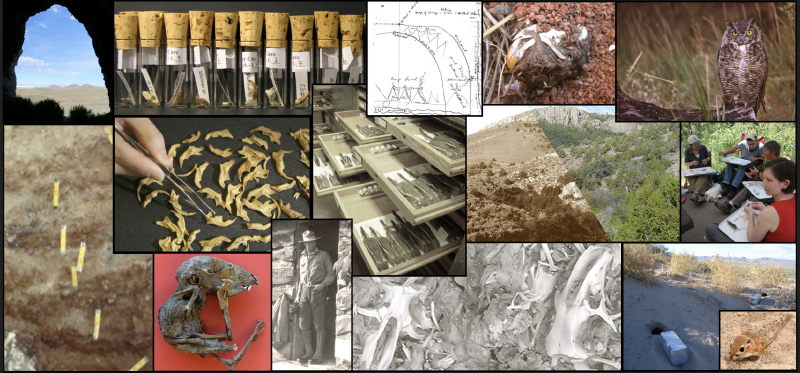
To date, our research focuses primarily on small mammals, raptors, and songbirds in western North America. We employ a variety of techniques in our research, including faunal and taphonomic analyses, functional and community-level ecological analyses, distribution mapping, isotope ecology, radiocarbon dating, geometric morphometrics, scanning electron microscopy, dental microwear texture analysis, and GIS. We welcome those interested in working in other systems and/or applying other approaches to the research themes outlined below as well, because there is nothing better than learning new things from each other!
Active Research Areas
Do the Dead Lie? Reliability of Ecological Data from Skeletal Remains
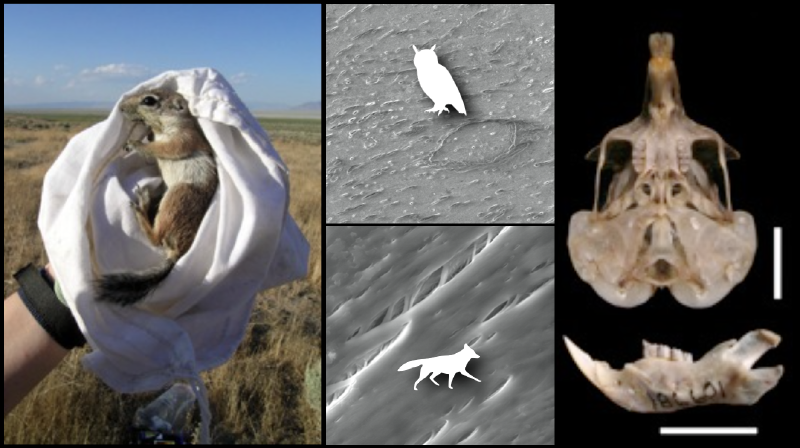
To confidently interpret ecological information captured in death-assemblages, one must assess the magnitude and direction of ecological and taphonomic bias. We approach this question using a live-dead comparative approach coupled with taphonomic analyses of skeletal breakage patterns and microscopic damage to bone surfaces. Questions we are exploring include: how closely do death-assemblages reflect the composition and structure of the living community? Does the selectivity of predators (e.g. raptors) alter the ecological signal recorded in the remains of their prey? What types of predators were responsible for creating a given death-assemblage? To what degree are death-assemblages spatially and temporally averaged?
The Distribution of Diversity Across Gradients in Time and Space
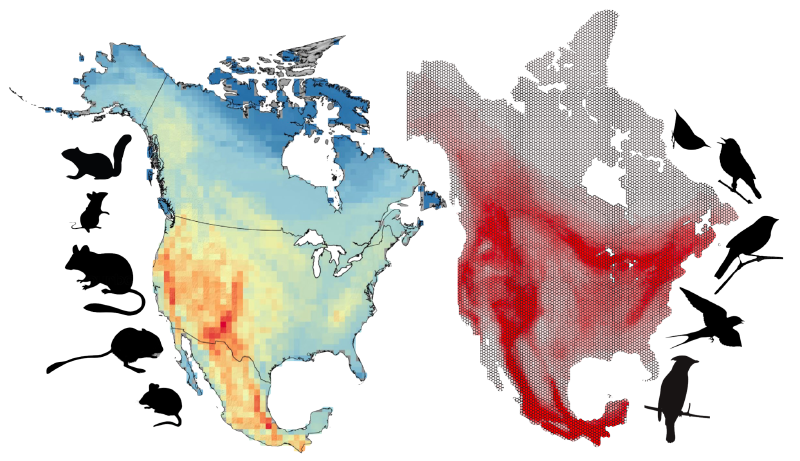
Striking patterns of species diversity can be seen across climatic, topographic, and geographic gradients today. Species diversity is also highly dynamic through time, responding to changes in environmental, ecological, and evolutionary pressures. Moreover, biodiversity is multidimensional, and taxonomic diversity is often not a one-for-one substitute for other biodiversity axes (e.g., ecological, functional, phylogenetic). Inferences gained from integrating across multiple spatial and temporal scales, as well as multiple axes of diversity, have the potential to increase our understanding of the origin and maintenance of biogeographic patterns, and can inform strategies for conservation. Questions we are exploring include: How has the intersection of landscape history, climate, biotic interactions, and human impacts shaped the distribution of diversity across space and time? How robust are the community properties of richness, evenness, biomass, and energy flow to underlying shifts in species composition? How do functional and phylogenetic diversity relate to community resiliency in the face of chronic and cumulative, or pulsed and ephemeral, perturbations?
Biotic Responses to Environmental Change
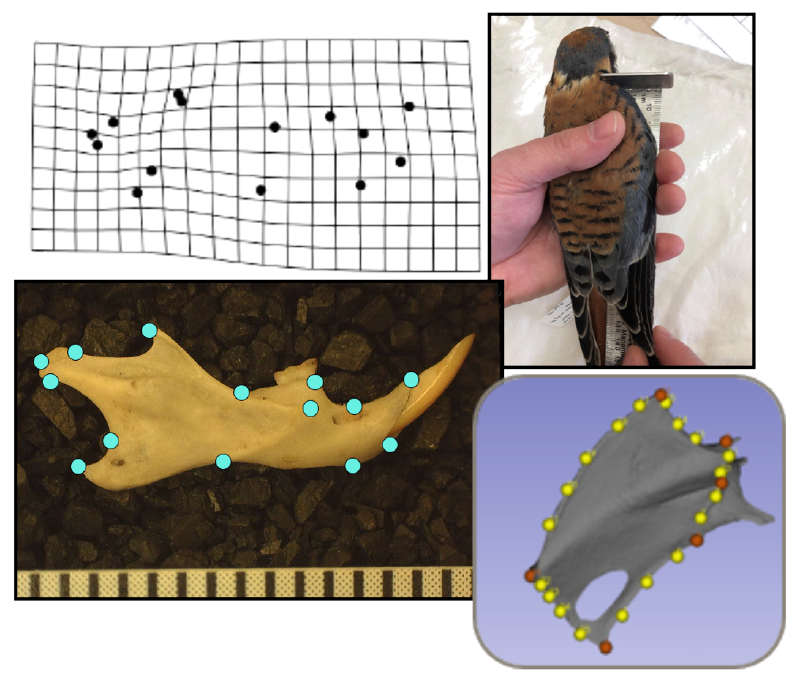
Environmental change pushes biotas to respond in multiple non-mutually exclusive ways. Species can shift their distributions to track their current niche, shift their niche to accommodate new conditions, or decline ultimately to extinction. Less clear are what traits shape species responses and the degree to which those traits are shared within and across phylogenetic groups. Questions we are exploring include: How does change in species occupancy through time across gradients in climate and elevation impact community composition, structure, and function? What role do changes in dietary niche breadth and morphology play in shaping the persistence of species over ecological and evolutionary time scales? To what degree are evolutionary or plastic sources of functional ecological variation coupled or independent? What factors increase or decrease the resilience of species to the myriad of natural and anthropogenic stressors they have experienced thus far and will face in the future?
Shifting Baselines in Terrestrial Systems
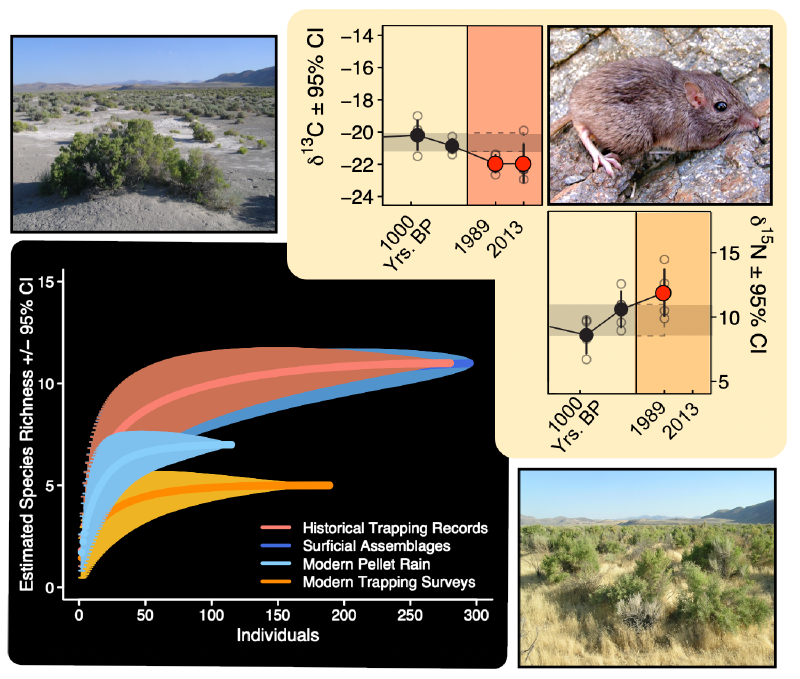
Establishing pre-19th and 20th century dynamic baseline conditions for terrestrial systems is important for predicting how species and communities are likely to respond to future environmental change. It also helps us evaluate the degree to which historical anthropogenic impacts have pushed modern systems beyond their range of natural variability. We are interested in how populations, species, and communities have responded to past climate warming and human impacts at the Pleistocene-Holocene transition, as compared to how responses to similar stressors are unfolding today. Questions we are exploring include: What is an appropriate baseline? What constitutes a non-analogue community? What species are currently at or beyond their historical baselines of environmental, behavioral, and/or morphological variation? Do different legacies of past land-use leave distinct traces in live-dead discordance? How has the introduction of invasive species (e.g. cheatgrass in the desert West) impacted resource use patterns, abundance dynamics, community composition, biotic interaction networks, and ecological function?
To learn more, please check out our publications and individual lab member’s webpages.